


 English
  Español
  اللغة العربية
  Russian
  Português
  Français
  ภาษาไทย
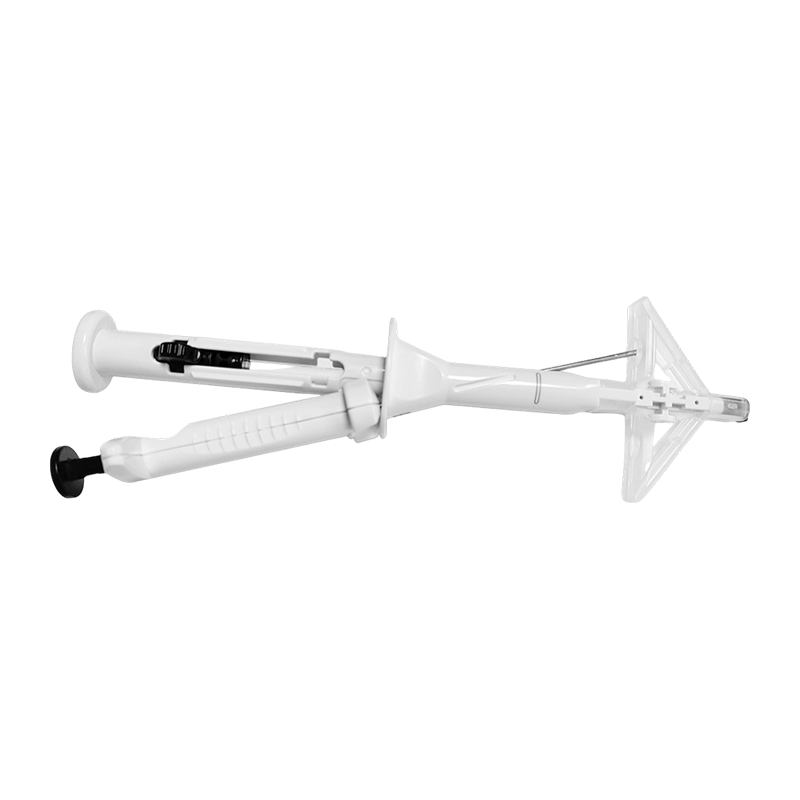
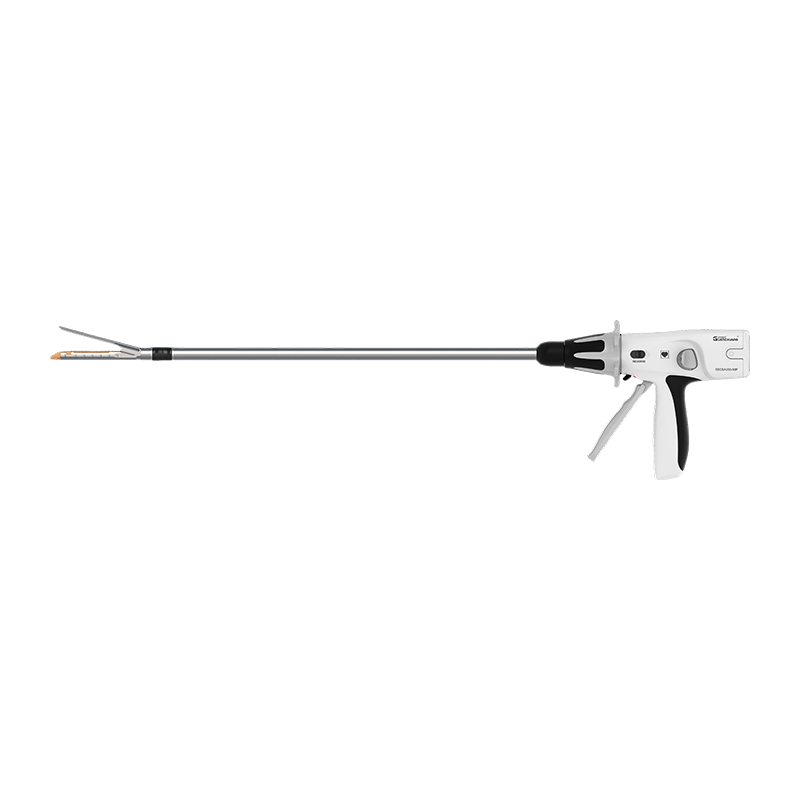
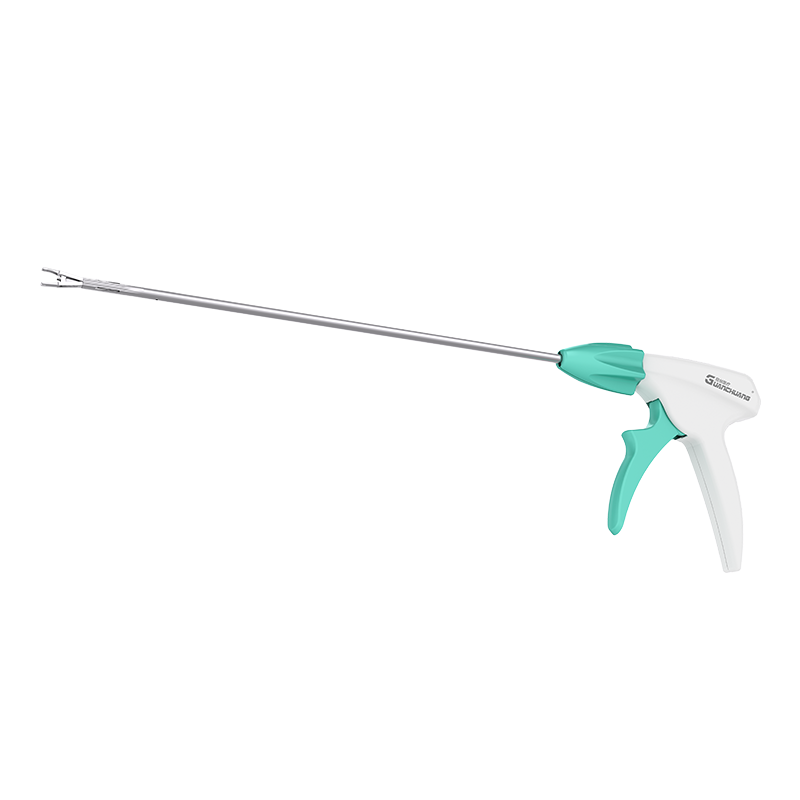
 It is a medical device specially used in minimally invasive surgery to gather tissues and perform percutaneous sutures to achieve precise closure of the fascia layer of the surgical incision.
Disposable Minimally Invasive Fascial Closer Suppliers
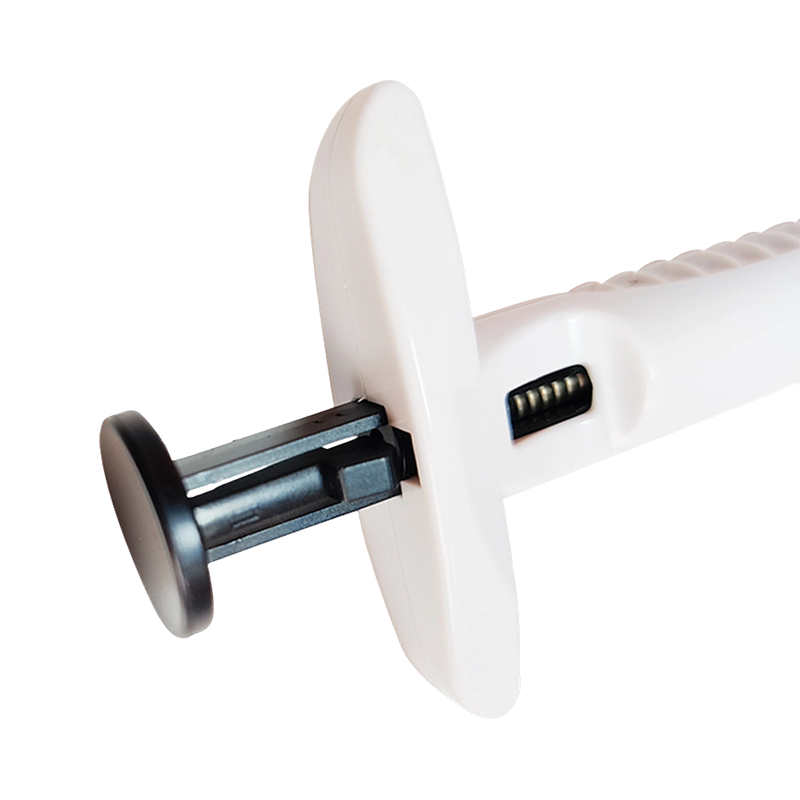
【Scope of application】
Disposable minimally invasive fascial closer are used to gather tissue and perform percutaneous sutures to close surgical incisions during laparoscopic surgery.
【Product performance】
1. Pull the push handle backward along the closing firmware handle. The sliding should be flexible and there should be no obvious looseness.
2. When the push handle reciprocates in a straight line along the closing firmware handle, the cable frame opens and closes freely without any jamming.
3. When the thread puller is in the open state, insert the grabber along the needle hole. The thread hook of the grabber should be able to hook the suture smoothly without any thread drop.
4. The button spring should have good elasticity, and there should be no jamming when the button is reset after being locked.
【Main structural components】
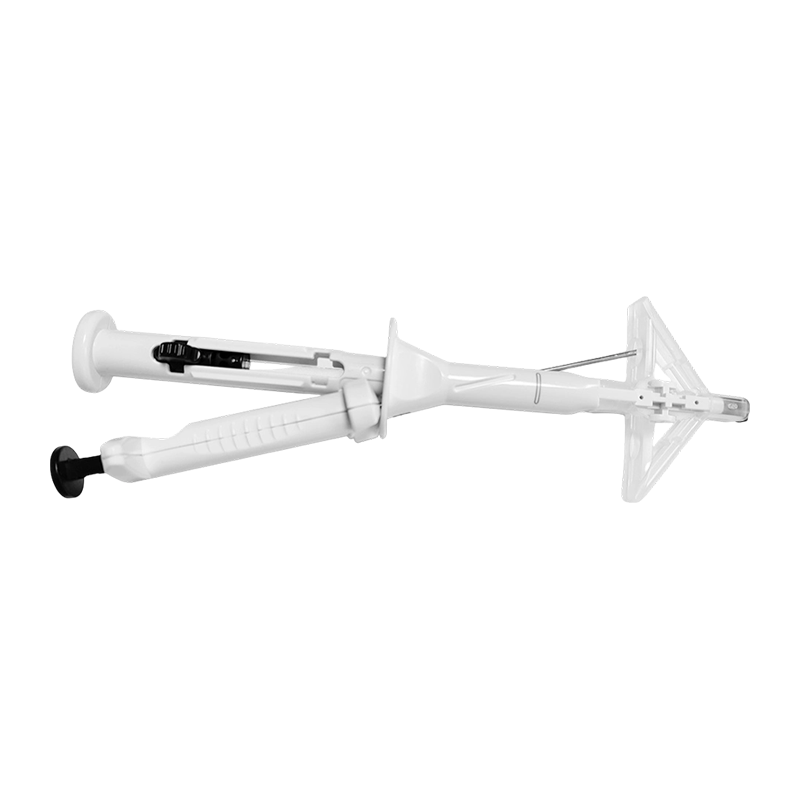
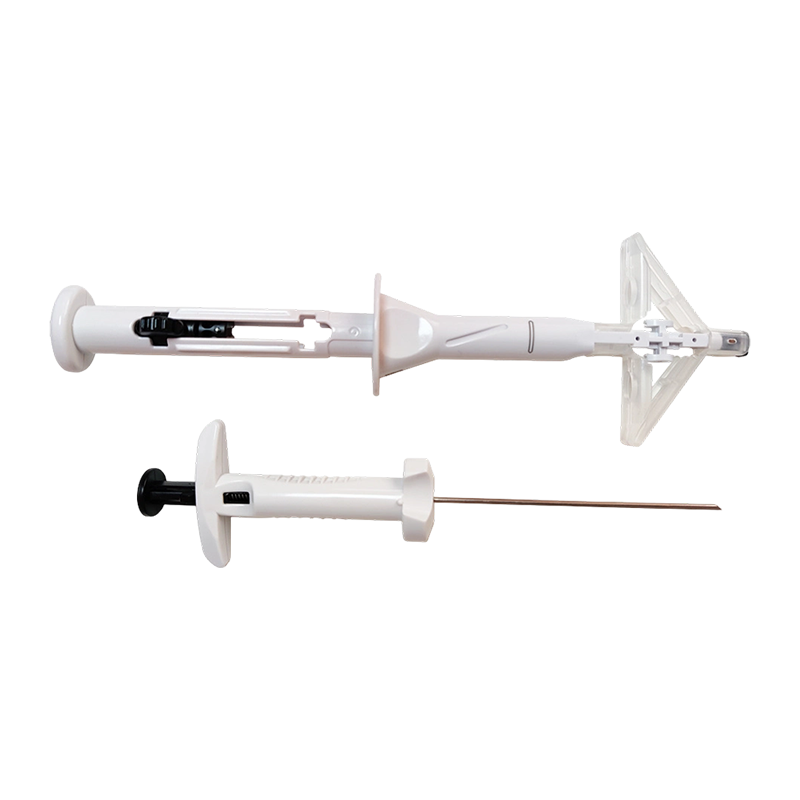
The disposable minimally invasive fascial closer consists of two parts: a closing firmware and a grabber. The closing firmware is mainly composed of a clamping block, a wire frame, a closing firmware handle, and a push handle; the grabber is mainly composed of a button, a button spring, and a grabber. It is composed of a handle, a puncture needle and a hook with thread. This product is supplied in a sterile condition, sterilized with ethylene oxide, and is intended for single use.
【Product model/specification】
The structural type of fascial closure device is shown in Figure 1 and Figure 2
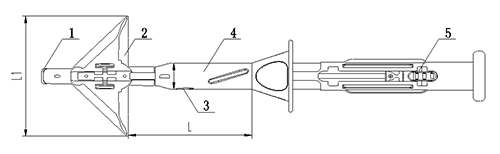
1. Clamping block
2. Cable stand
3. Threading a pinhole
4. Close firmware handle
5. Push handle
2. Figure 1 Structural diagram of closing firmware
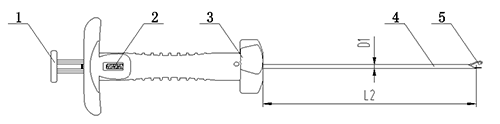
1. Button
2. Button spring
3. Grabber handle
4. Puncture needle
5. With wire hook
Figure 2 Structural diagram of the grabber
Basic dimensions of disposable minimally invasive fascial closer Unit: mm
|
model |
Effective length of closing hardware handle (L) |
Wire draw frame opening size (L1) |
Working length of puncture needle (L2) |
Closure handle outer diameter (D) |
Puncture needle outer diameter (D1) |
|
GCJM |
58±5 |
62±5 |
86±5 |
13±2 |
1.8±0.05 |
【Accessories】 None
【Instructions】
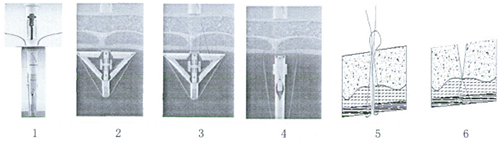
1. Removing the Instrument: First, inspect the packaging for damage (do not use if the packaging is damaged). Then, tear open the packaging and remove the closure hardware and grasper.
2. Preloading Sutures: Pass the sutures through the thread guide, clamping block, and thread guide around the closure hardware, leaving ample thread length (Figure 1). (Sutures are not included with this product, but must be used with 2-0 or 0 sutures.)
3. Installing the Closure Hardware: First, insert the closure hardware through the incision. Then, press the push handles on both sides of the closure hardware, pull upward and lock to expand the thread guide. Unfold the sutures and pull the closure hardware upward to ensure the guide is flush against the abdominal wall (Figure 2).
4. Removing Sutures: Insert the grasper through the needle hole of the closure hardware until it stops. Press the grasper button and lock it. Pull back on the grasper needle to remove the suture. Repeat the same process to remove the suture on the other side (Figure 3). 5. Remove the closure: Press and hold the push handles on both sides of the closure, push downward, and lock to close the suture holder. Then, lift the closure outward along the incision, remove the closure, and leave the suture in place (Figure 4)(Figure 5).
5. Suture the incision: Tighten the sutures with the suture tips, tie a knot, and suture the fascia of the incision (Figure 6).
-
 0
0Factory Area (m² )
-
 0+
0+Export Countries

Jiangsu Guanchuang Medical Technology Co., Ltd.
Founded in 2014 and headquartered in Changzhou, Jiangsu, Guanchuang Medical Technology Co., Ltd. is a professional manufacturer of surgical instruments, integrating R&D, production, sales, and service.
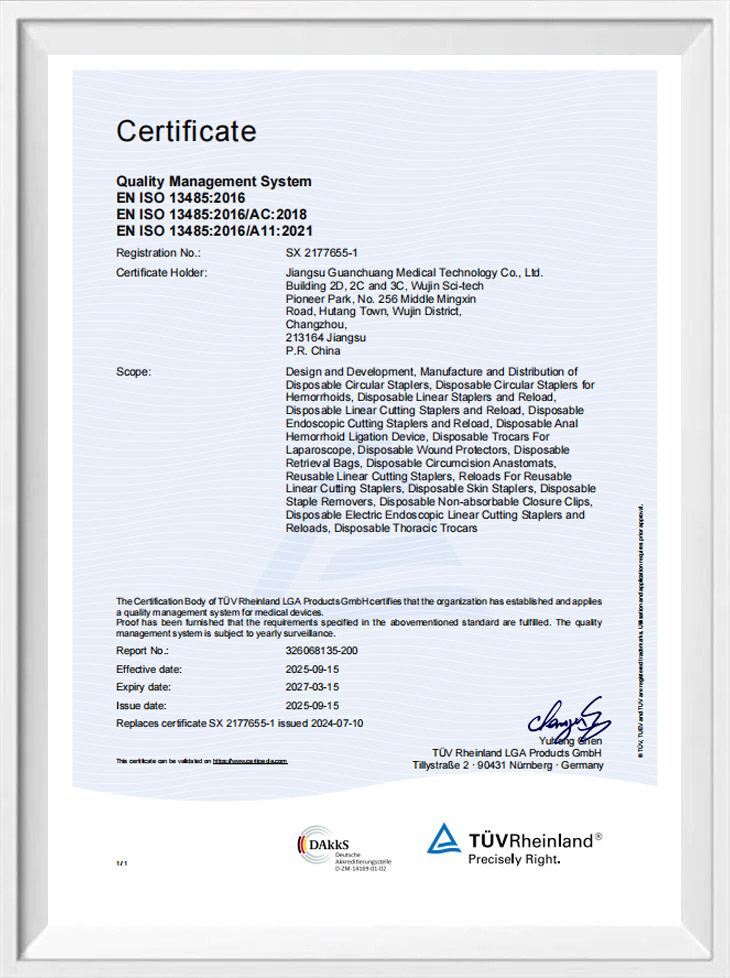
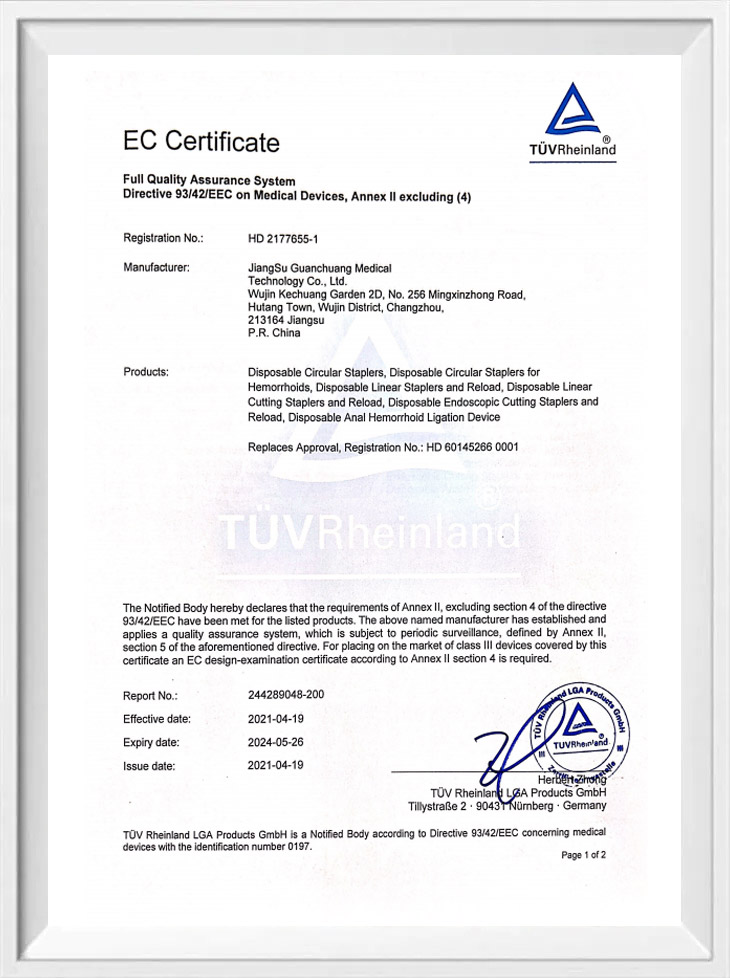
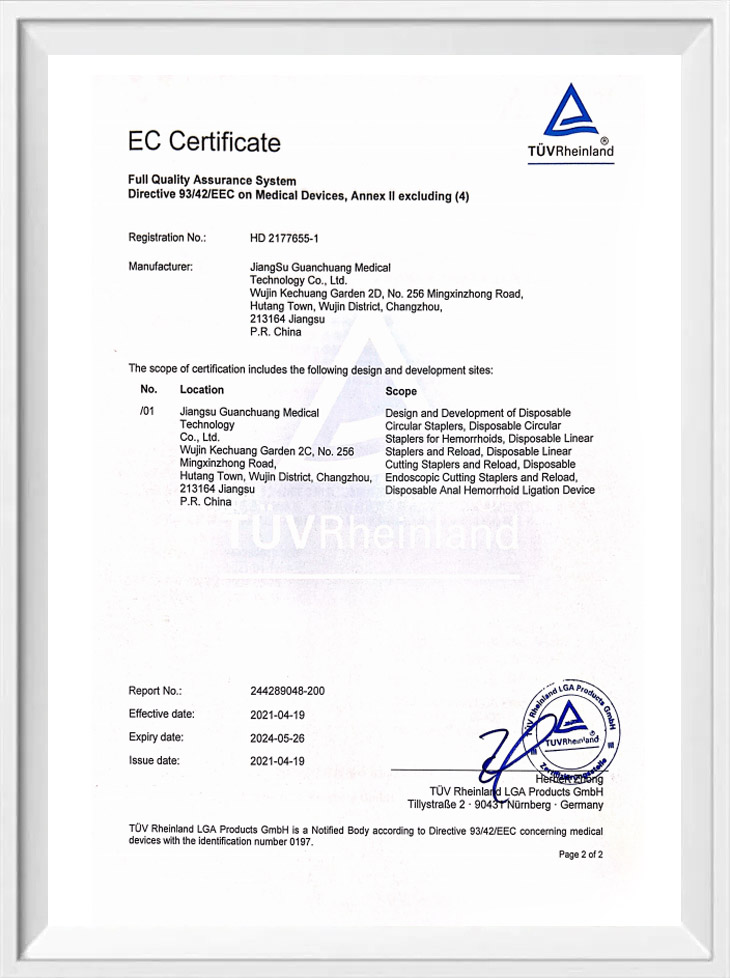
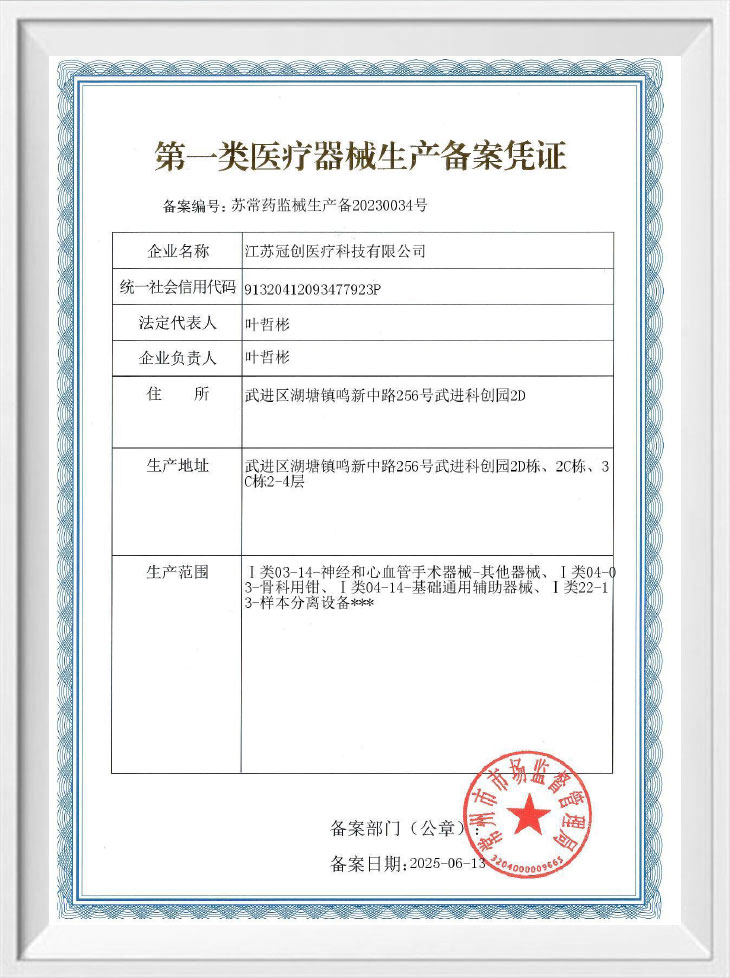
The company has obtained ISO 13485 quality management system certification, CE certification, and other international approvals. As Disposable Minimally Invasive Fascial Closer Manufacturers and Disposable Minimally Invasive Fascial Closer Suppliers in China, our products are widely used in general surgery, thoracic surgery, urology, digestive surgery, and more, and are exported to Southeast Asia, Russia, the Middle East, South America, and other regions.
Guanchuang Medical is dedicated to providing high-quality surgical instruments and comprehensive services to healthcare institutions worldwide. Wholesale Disposable Minimally Invasive Fascial Closer Factory. We offer efficient production, strict quality control, timely delivery, and continuous after-sales support, ensuring professional assurance at every step.
Explore more
The company has obtained ISO 13485 quality management system certification, CE certification, and other international approvals. As Disposable Minimally Invasive Fascial Closer Manufacturers and Disposable Minimally Invasive Fascial Closer Suppliers in China, our products are widely used in general surgery, thoracic surgery, urology, digestive surgery, and more, and are exported to Southeast Asia, Russia, the Middle East, South America, and other regions.
Guanchuang Medical is dedicated to providing high-quality surgical instruments and comprehensive services to healthcare institutions worldwide. Wholesale Disposable Minimally Invasive Fascial Closer Factory. We offer efficient production, strict quality control, timely delivery, and continuous after-sales support, ensuring professional assurance at every step.
Step into Guanchuang Medical and experience our professional team and corporate culture.

News & Insights
Discover our company news and industry insights, keeping pace with the latest trends in medical devices.
-
Jun 27,2024

-
Feb 28,2024
-
Feb 22,2024
-
Dec 30,2023
-
Dec 22,2023
Message Us Right Now!

- Quick Links
- About Us
- Quality
- Service
- News
- Contact us
- Our Product
- Disposable Endoscopic Laparoscopic Instruments
- Disposable Wound Closure
- Thoracic Surgery Instruments
- Electrosurgery Instruments
- Open Surgical Instruments
- Urinary Anorectal Surgery Instruments
- Gastroenterology Surgical Instruments
- Medical Auxiliary Equipment
- Blood Preparation Device
- Contact us
- Tel:+86-519-69878833
- Phone:+86-13584319056
- E-mail:[email protected]
- Address:Building 2D, 2C and 3C, Wujin Sci-tech Pioneer Park, No. 256 Middle Mingxin Road, Hutang Town, Wujin District, Changzhou, 213164 Jiangsu P.R. China

The information provided on this website is intended for use only in countries and jurisdictions outside of the People's Republic of China.
Approval No. 20140121
