


 English
  Español
  اللغة العربية
  Russian
  Português
  Français
  ภาษาไทย
Industry News
Endoscopic Biopsy Forceps: EO Sterilization, Safety & Selection Guide
Content
- 1 What Makes Endoscopic Biopsy Forceps a Clinical Essential
- 2 How Endoscopic Biopsy Forceps Work
- 3 EO Sterilization: Why It Is the Right Method for Disposable Forceps
- 4 Sterility Assurance: Single-Use vs. Reusable Forceps
- 5 Selecting the Right Forceps: Specifications That Matter
- 6 Quality Benchmarks for Procurement Decisions
What Makes Endoscopic Biopsy Forceps a Clinical Essential
Endoscopic biopsy forceps are the most frequently deployed accessory in any gastrointestinal or pulmonary endoscopy unit. Their job is straightforward in principle — grasp and remove a small piece of tissue from an internal mucosal surface — but the clinical demand placed on them is anything but simple. A single procedure may require multiple passes, each one expected to deliver a clean, intact specimen adequate for histologic assessment. Forceps that tear tissue, fail to close fully, or transmit cross-contamination between patients compromise diagnostic accuracy and patient safety simultaneously.
The shift toward single-use, EO sterilized endoscopic forceps over the past decade reflects a growing recognition that reusable instruments carry an inherent sterility risk that no reprocessing protocol can eliminate with complete confidence. The structural complexity of biopsy forceps — coiled metal sheath, hinged jaw pivot, narrow inner lumen — creates surfaces that standard cleaning cycles cannot reliably reach. Single-use devices, sterilized before dispatch and opened at the point of care, remove that variable from the equation entirely.
How Endoscopic Biopsy Forceps Work
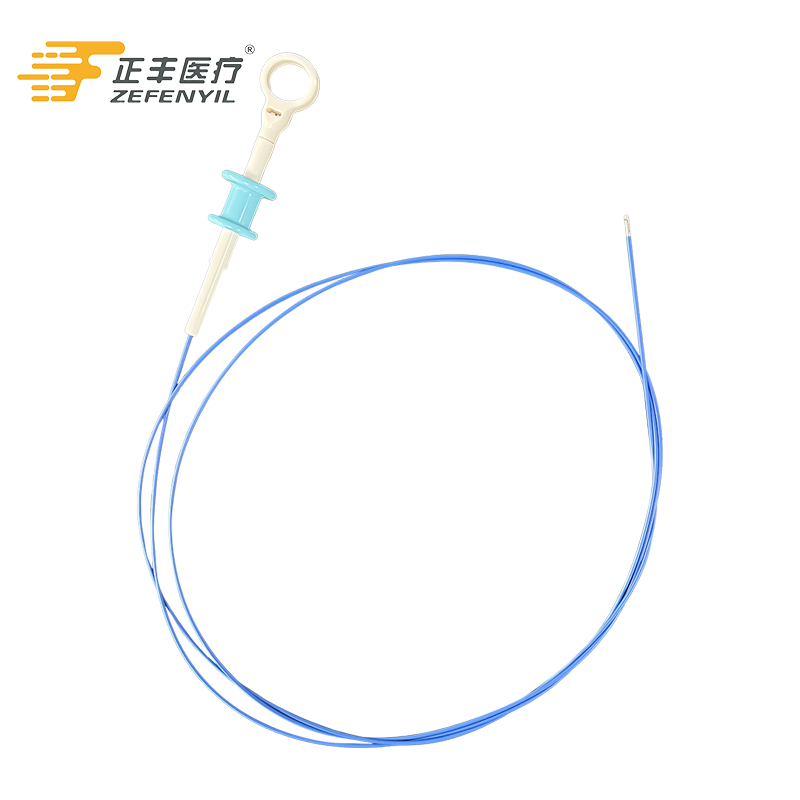
The mechanical design of endoscopic biopsy forceps consists of three core elements working in coordination: the jaw assembly at the distal tip, a flexible coiled sheath running the instrument's full length, and a proximal handle that the clinician operates throughout the procedure.
The jaw assembly holds two opposing cups connected by a pivot pin and driven by a central wire threaded through the sheath. Pulling the handle slider back retracts the wire and opens the jaws; pushing it forward closes them, capturing tissue between the cup edges. The geometry of those edges — their sharpness, alignment, and closure consistency — determines whether the specimen is cleanly excised or torn. A fragmented or crushed sample may be diagnostically inconclusive, requiring a repeat biopsy and additional patient exposure.
The sheath must balance two competing demands: flexibility sufficient to follow the bends of a colonoscope or bronchoscope without kinking, and enough column strength to transmit the drive wire's axial force to the jaw without buckling. Instruments that fail either requirement cause procedural problems — channel damage from a stiff sheath, or imprecise jaw action from an overly compliant one.
EO Sterilization: Why It Is the Right Method for Disposable Forceps
Ethylene oxide (EO) sterilization has become the established method for processing disposable endoscopic biopsy forceps, and the reasons are rooted in the physical properties of the sterilant itself. EO is a gas that penetrates packaging materials, polymer sheaths, and the internal cavities of complex instruments at low temperatures — conditions that steam autoclaving cannot match without degrading the plastic components, lubricants, and close-tolerance metal parts that disposable forceps depend on.
The EO sterilization cycle exposes packaged forceps to gas at controlled temperature and humidity, achieving broad-spectrum microbial kill including bacteria, spores, and viruses. This is followed by a mandatory aeration phase during which residual EO dissipates from the device materials. This step is not procedural routine — it is a patient safety requirement. Residual ethylene oxide retained in a device after inadequate aeration can cause mucosal irritation and cytotoxic reactions upon tissue contact.
Regulatory and manufacturing standards address this directly. The sampling forceps are sterilized with ethylene oxide, and the residual ethylene oxide content must not exceed 10μg/g in the finished device. This threshold, consistent with ISO 10993-7 biocompatibility requirements, is verified through validated aeration cycles and batch-level residual testing before product release. Procurement teams should confirm that a supplier can provide this documentation as part of standard quality records.
Beyond residual safety, EO sterilization preserves instrument performance. Jaw sharpness, pivot function, and sheath integrity arrive at the procedure in the same condition they left the manufacturing line — an assurance that erodes with every reprocessing cycle applied to a reusable instrument.
Sterility Assurance: Single-Use vs. Reusable Forceps
The sterility debate between reusable and disposable endoscopic forceps is not theoretical. Prospective studies culturing reusable forceps after standard reprocessing — including EO gas treatment — have recovered viable pathogens in a measurable percentage of instruments. The structural complexity that makes biopsy forceps effective also makes them resistant to complete decontamination: organic material lodged in the coil interstices or around the jaw pivot can shield microorganisms from sterilants.
Disposable EO sterilized endoscopic forceps eliminate this risk category. Each unit is manufactured under cleanroom conditions, sterilized, sealed, and delivered with a sterility guarantee backed by production lot testing. The requirement that the sampling forceps are sterilized with ethylene oxide and must be sterile at the point of use is met by design — not by hoping a reprocessing cycle was performed correctly.
The practical benefits for endoscopy units extend beyond infection control:
- No reprocessing labor, tracking, or cycle validation required
- No degradation of jaw sharpness or mechanical function from repeated sterilization
- Eliminated liability associated with reprocessing failures or cross-contamination events
- Simplified inventory management with clear expiry dating on each sterile pack
Selecting the Right Forceps: Specifications That Matter
Choosing the correct endoscopic biopsy forceps configuration for a given procedure requires matching several technical parameters to the clinical context. The following table summarizes the key variables and their practical implications:
| Parameter | Common Options | Selection Guidance |
| Sheath outer diameter | 1.8mm / 2.3mm | Must match working channel of endoscope in use |
| Cup geometry | Oval / Alligator / Fenestrated | Oval for routine use; alligator for firm tissue; fenestrated to preserve specimen architecture |
| Central spike | With / Without | Aids stabilization on smooth mucosa; avoid in bronchoscopy where it may lacerate delicate tissue |
| Sheath coating | Plastic coated / Uncoated | Coated reduces friction and channel wear; recommended for high-volume colonoscopy units |
| Working length | 1,650mm / 2,300mm | Match to endoscope insertion tube length with margin for full jaw extension at target site |
| Handle type | Fixed / Rotatable | Rotatable allows jaw orientation adjustment without forceps withdrawal — useful for tangential targets |
For units operating multiple endoscope models, it is worth standardizing on two or three forceps configurations that cover the majority of procedural needs, rather than maintaining a fragmented inventory of rarely used variants.
Quality Benchmarks for Procurement Decisions
Specifications describe intended performance. Quality benchmarks reveal whether a manufacturer can deliver that performance reliably across production batches — not just in a promotional sample.
Jaw Precision and Closure Consistency
The two cup halves must align accurately when closed, with no lateral offset or residual gap at the cutting edge. Misalignment tears rather than cuts tissue, producing fragmented specimens. This requires tight machining tolerances on the pivot pin fit and cup geometry — parameters that should be part of a supplier's incoming quality inspection records.
Sheath Performance Under Angulation
The sheath should transmit drive wire force reliably with the endoscope at acute angles, reflecting real procedural conditions. Suppliers should be able to demonstrate angulation test data showing consistent jaw actuation force across the operating range of the instrument.
Sterilization and Biocompatibility Documentation
For EO sterilized endoscopic forceps, ask for residual EO test reports confirming compliance with the 10μg/g limit, sterilization validation records for the production lot, and ISO 10993 biocompatibility data. CE marking under the EU Medical Device Regulation and ISO 13485 certification provide the foundational quality management framework, but product-specific test documentation is what confirms the standard is being met in practice.


- Quick Links
- About Us
- Quality
- Service
- News
- Contact us
- Our Product
- Disposable Endoscopic Laparoscopic Instruments
- Disposable Wound Closure
- Thoracic Surgery Instruments
- Electrosurgery Instruments
- Open Surgical Instruments
- Urinary Anorectal Surgery Instruments
- Gastroenterology Surgical Instruments
- Medical Auxiliary Equipment
- Blood Preparation Device
- Contact us
- Tel:+86-519-69878833
- Phone:+86-13584319056
- E-mail:[email protected]
- Address:Building 2D, 2C and 3C, Wujin Sci-tech Pioneer Park, No. 256 Middle Mingxin Road, Hutang Town, Wujin District, Changzhou, 213164 Jiangsu P.R. China

